
18–22 May 2026 • ICFO Auditorium • Castelldefels (Barcelona, Spain)

Quantum Energy Initiative Workshop

The third Quantum Energy Initiative Workshop will happen at ICFO, Castelldefels (Barcelona, Spain) from the 18th to the 22nd of May 2026. Save the date !

Launched in August 2022, the Quantum Energy Initiative is fostering a worldwide community of experts willing to develop scientific approaches to evaluating and minimizing the physical resource costs of emerging quantum technologies. This requires the synergy of a broad range of expertises, from fundamental quantum physics to enabling technologies, from hardware to software, from research to industry.

Building on the strong foundations at the first workshop (Singapore, Nov 2023), and second workshop (Grenoble, Jan 2025), this third workshop will bring together highly renowned speakers of all these areas, to provide their vision on these exciting and essential questions. It will also leave time for discussions and crossed-fertilization to the build new methodologies and roadmaps.

Registration

Important update
  • Abstract submission is closed.
  • Registration is closed.
  • No fee is charged, but registration is required for planning (seating, catering, badges).
  • After registering, you will receive a confirmation email.

Invited Speakers

Topics of the workshop

Research on energy or other resources in the following contexts:

Committee

Organising

Coordination: Raja Yehia and Federico Centrone (ICFO, Barcelona), Mercè Latorre, Jordi Pinyol, Víctor Herrero, Olivier Ezratty (EPITA, Paris)

Scientific

Robert Whitney (Université Grenoble Alpes & CNRS), Alexia Auffèves (Majulab, CNRS, Singapore), Alimuddin Mir, Beatriz Polo, Victor Champain (ICFO, Barcelona)

More information to come. Stay tunned!

Agenda

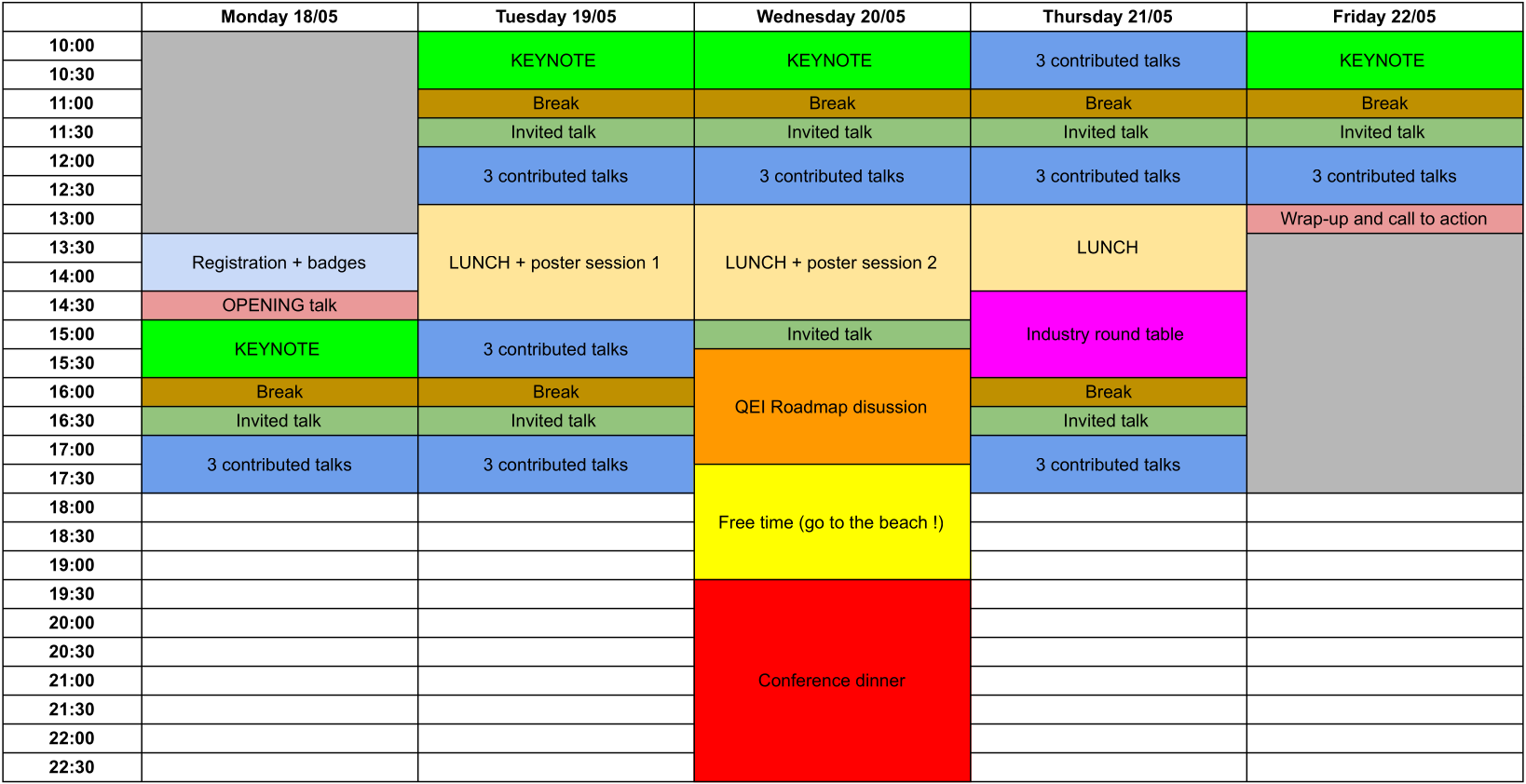
Preliminary program (subject to change).

QEI2026 agenda

Schedule (subject to change).

Monday 18/05
  • 13:30 Registration + badges
  • 14:30 Opening talk
  • 15:00 Keynote — Juan MR Parrondo
    Title: Information flows in nanomachines
    See abstract
    The original Maxwell demon controls a system by utilizing information about its microstate. In practical applications, it is also interesting to consider autonomous Maxwell demons, i.e., bipartite systems in which one subsystem acts as measurement device and controller for the other. The concept of information flow has been introduced to study the informational aspects of these autonomous bipartite systems in the steady state. This framework makes it possible to interpret certain nanomachines as autonomous Maxwell’s demons or information engines. In this talk, I will present a pedagogical review of these concepts and apply them to a specific energy transducer at the nanoscale: a device that couples electron tunneling through a carbon nanotube to its mechanical oscillations.
  • 16:00 Break
  • 16:30 Invited talk — James Quach
    Title: Powering Quantum Computation with Quantum Batteries
    See abstract
    Quantum computers currently depend on room-temperature electronics to continuously supply energy to cryogenic qubits, creating major challenges in scalability and heat dissipation. In this talk, I will present a new approach in which quantum batteries act as intrinsic energy sources for quantum computation. Using a shared bosonic mode coupled to qubits, we show that quantum energy can be coherently recycled throughout a computation, enabling universal quantum logic using only qubit-frequency detuning. The architecture supports fast multiqubit gates, parity measurements, and superextensive scaling effects characteristic of quantum batteries, while eliminating individual microwave drive lines. Simulations with superconducting qubits demonstrate high-fidelity operation under realistic experimental conditions. Beyond improving energetic efficiency, this approach could significantly reduce wiring overhead and increase the scalability of cryogenic quantum processors.
  • 17:00 Contributed talks
    • Vasco Cavina
      Exact requirements for battery-assisted qubit gates
    • Eric Lutz
      Combining energy efficiency and quantum advantage in cyclic machines
    • Alan Santos
      Quantum charging advantage in superconducting solid-state batteries
Tuesday 19/05
  • 10:00 Keynote — Gerard Milburn
    Title: The thermodynamic constraints of physical learning machines.
    See abstract
    Algorithms make implicit assumptions about hardware; the lesson of quantum computation. I will discuss the classical and quantum thermodynamics of learning machines. By treating learning as the transformation of sampled probability distributions, classical and quantum approaches can be unified. The goal is to find a physical implementation that minimises the thermodynamic cost, including bandwidth. Quantum photonics offers the most promising technology.
  • 11:00 Break
  • 11:30 Invited talk — Natalia Ares
    Title: Thermodynamics of single-electron information processing in quantum dots
    See abstract
    In this talk, I will present recent experiments on the thermodynamics of semiconductor quantum-dot devices driven by single-electron tunnelling. I will first discuss the realization of a nanoscale clock in which individual tunnelling events generate a measurable tick signal, and show that the dominant source of dissipation arises not from the clock mechanism itself but from the energetic cost of detecting and recording the ticks. I will then present a quantum-dot Szilard engine that extracts work efficiently under fast driving, and show how optimized protocols reveal a fundamental trade-off between power output and power fluctuations. Finally, I will present recent results on information erasure in quantum-dot systems, including a nonequilibrium extension of Landauer’s bound. These experiments establish quantum dots as a powerful platform for investigating the thermodynamics of information processing at the single-electron level.
  • 12:00 Contributed talks
  • 13:00 Lunch + poster session
  • 15:00 Contributed talks
  • 16:00 Break
  • 16:30 Invited talk — Chris Langer
    Title: Quantinuum Helios - a 98 qubit ion-based quantum computer
    See abstract
    Helios is Quantinuum's 3rd generation quantum computer. It houses 98 moveable ion qubits with fidelities greater than 99.92% across all qubit pairs. I will describe how Helios works and benchmarks of its performance. I will showcase applications run on Helios both at the physical level and the logical level. Lastly, I will highlight recent results in fault-tolerant quantum computing on Helios.
  • 17:00 Contributed talks
    • Harshit Verma
      The energetic cost of loading classical data in quantum computers
    • Gonzalo Manzano
      Quantum Time Crystal Clock and its Performance
    • Irene D’Amico
      Fractional control gate protocols for energy storage and quantum engines
Wednesday 20/05
  • 10:00 Keynote — Fernando Brandão
    Title: Quantum Gibbs Sampling
    See abstract
    I’ll discuss the problem of simulating thermal physics/chemistry on a quantum computer, focusing on recent advances in developing fast and physically motivated quantum algorithms for Gibbs sampling.
  • 11:00 Break
  • 11:30 Invited talk — Arnau Riera
    Title: Beyond Gate Counts: Time and Energy in Quantum Simulation
    See abstract
    Quantum simulation can be approached through digital circuits, analog dynamics, or classical computation, each with different costs and limitations. In this talk, we will compare these paradigms for Hamiltonian simulation using representative spin models as benchmarks. The focus will be on how accuracy requirements translate into physical resources: circuit depth, runtime, accumulated errors, fidelity constraints, and energy consumption. The goal is to move beyond gate counts toward a more complete picture of time-to-solution and energy-to-solution in quantum simulation.
  • 12:00 Contributed talks
    • Yasser Omar
      Benchmarking the Energetic Performance of Different Platforms of Quantum Computation
    • Karol Horodecki
      Quantification of the energy consumption of entanglement distribution
    • Jakub Czartowski
      Distributed Quantum Thermodynamics: Local Operations and Resource Engines
  • 13:00 Lunch
  • 14:30 Invited talk — Nelly Maria Canessa Araujo
    Title: Efficient for Whom? Socially Shaping Scalability in Quantum Technologies
    See abstract
    Quantum technologies are often framed as a technical challenge of improving coherence, reducing error rates, and optimizing energy efficiency (Preskill, 2018). This presentation argues that scalability is also a socio-technical process shaped by infrastructures, institutions, supply chains, and public legitimacy (Hughes, 1987; Jasanoff, 2004). Drawing on Science and Technology Studies (STS) and responsible innovation approaches (Stilgoe, 2018), the talk examines how scalable quantum systems depend upon energy-intensive infrastructures such as cryogenic cooling, specialized materials, and large-scale computational environments (Krinner et al., 2019). Technological systems rarely replace older infrastructures through efficiency gains alone, but instead accumulate new layers of material and energetic demand (Fressoz 2024) . Historical comparisons with infrastructure-intensive technologies such as Nuclear Power further demonstrate that technical efficiency alone does not guarantee adoption or long-term sustainability (Wynne, 1992). Rather than critiquing the physics itself, this contribution proposes a broader framework for evaluating quantum technologies that integrates physical optimization with questions of governance, sustainability, and societal legitimacy.
  • 15:00 QEI Roadmap discussion
  • 17:00 Free time (go to the beach!)
  • 19:30 Conference dinner
Thursday 21/05
  • 10:00 Contributed talks
    • Lirandë Pira
      Cost of non-linearity for learning in quantum systems
    • Yukuan Tao
      Complexity and Energy Trade-off in Quantum Protocols
    • Yutong Luo
      Thermodynamic criteria for signaling in quantum channels
  • 11:00 Break
  • 11:30 Invited talk — Ariane Soret
    Title: Quantum Energetic Advantage before Computational Advantage in Boson Sampling
    See abstract
    Understanding the energetic efficiency of quantum computers is essential for assessing their scalability and determining whether quantum technologies can outperform classical computation beyond runtime alone. In this work, we analyze the energy cost required to solve the Boson Sampling problem, a paradigmatic task for quantum advantage, using a realistic photonic quantum computing architecture. Using the Metric–Noise–Resource methodology [1], we establish a quantitative connection between experimental control parameters, dominant noise processes, and energetic resources through a performance metric tailored to Boson Sampling. We estimate the energy cost per sample and identify operating regimes that optimize energetic efficiency. By comparing the energy consumption of quantum and state-of-the-art classical implementations, we demonstrate the existence of a quantum energetic advantage – defined as a lower energy cost per sample compared to the best-known classical implementation – that emerges before the onset of computational advantage, even in regimes where classical algorithms remain faster. Finally, we propose an experimentally feasible Boson Sampling architecture, including a complete noise and loss budget, that enables a near-term observation of quantum energetic advantage.
  • 12:00 Contributed talks
    • Felix Binder
      Can intersubjectivity emerge from thermodynamics?
    • Yoann Piétri
      Theoretical Lower Bounds on the Energetic Consumption of Continuous-Variable Quantum Key Distribution
    • Sofia Sevitz
      Harnessing electronic transport to enhance quantum battery charging
  • 13:00 Invited talk — Michael Vasmer
    Title: Simplified circuit-level decoding using Knill error correction
    See abstract
    Quantum error correction will likely be essential for building a large-scale quantum computer, but it comes with significant requirements at the level of classical control software. In particular, a quantum error-correcting code must be supplemented with a fast and accurate classical decoding algorithm. Standard techniques for measuring the parity-check operators of a quantum error-correcting code involve repeated measurements, which both increases the amount of data that needs to be processed by the decoder, and changes the nature of the decoding problem. Knill error correction is a technique that replaces repeated syndrome measurements with a single round of measurements, but requires an auxiliary logical Bell state. Here, we provide a theoretical and numerical investigation into Knill error correction from the perspective of decoding. We give a self-contained description of the protocol, prove its fault tolerance under locally decaying (circuit-level) noise, and numerically benchmark its performance for quantum low-density parity-check codes. We show analytically and numerically that the time-constrained decoding problem for Knill error correction can be solved using the same decoder used for the simpler code-capacity noise model, illustrating that Knill error correction may alleviate the stringent requirements on classical control required for building a large-scale quantum computer.
  • 13:30 Lunch
  • 15:00 Industry round table
    • Cécile Perrault — Alice & Bob
    • Ariane Soret — Quandela
    • Etienne Decossin — EDF
    • Pierre Jaeger — IBM
    • Joseph Mikael — Quobly
    • Mert Bozkurt — Quantware
    • Yasser Omar — PQI
  • 16:30 Break
  • 17:00 Contributed talks
Friday 22/05
  • 10:00 Keynote — Christiane Koch
    Title: What does it take to cool many-body quantum systems?
    See abstract
    The development of efficient techniques to cool quantum systems has been instrumental for the emergence of quantum technologies. Preparing a many-body quantum system in a pure target state is, for example, a prerequisite for its use to study complex interactions or implement quantum computations. State preparation needs to work irrespective of the initial state of the quantum system and thus requires reduction of both system energy and entropy. A powerful way to engineer such desired dissipative dynamics is by coupling to auxiliary qubits. While protocols where the number of auxiliary qubits increases with the system size are of limited practical usefulness, "dilute" cooling is possible for certain many-body quantum systems. I will discuss two examples of frustration-free one-dimensional spin chains and show that they can be driven into their (topological) ground state by measuring two adjacent system sites only. I will then ask what it takes to make the auxiliary qubits resemble a cold bath in nature. A natural cold bath will cool a quantum system without any knowledge of the system’s spectrum or quantization axis. Assuming a reservoir of auxiliary qubits prepared in their ground state, I will introduce a protocol for universal cooling of many-body quantum systems.
  • 11:00 Break
  • 11:30 Invited talk — Nelly Ng
    Title: When do we have (robust) catalytic advantage?
    See abstract
    Catalysis refers to the possibility of enabling otherwise inaccessible quantum state transitions by supplying an auxiliary system, provided that the auxiliary is returned to its initial state at the end of the protocol. We show that previous studies on catalysis are largely impractical, because even small errors in the system’s initial state can irreversibly degrade the catalyst. To overcome this limitation, we introduce “robust catalytic transformations” and explore the fundamental extent of their capabilities.
  • 12:00 Contributed talks
    • Manabendra Nath Bera
      Fundamental Limitations on the Reliabilities of Power and Work in Quantum Batteries
    • Iris Paparelle
      Experimental memory control in continuous variable optical quantum reservoir computing
    • Png Wen Han
      Sub-Bath Cooling in Bosonic Systems
  • 13:00 Wrap-up and call to action

Venue & Travel

Address

ICFO – The Institute of Photonic Sciences
Mediterranean Technology Park (PMT)
Av. Carl Friedrich Gauss, 3
08860 Castelldefels (Barcelona), Spain
Tel.: (+34) 93 553 4002 · E-mail: secretariat@icfo.eu

ICFO is in the Parc Mediterrani de la Tecnologia (PMT), in the seaside town of Castelldefels, next to the Canal Olímpic and about ten minutes from the beach.

Open in Google Maps

Best option: Bus X95 (Barcelona ↔ Castelldefels)
  • Recommended: Take X95 from Barcelona (Plaça Catalunya / Rda. Universitat) to Castelldefels (La Muntanyeta area). It’s a direct, frequent express bus to Castelldefels.
  • It will pass in front of PMT/ICFO campus, go through a roundabout and then go back and stop in front of the campus.
  • Cross the street to reach the campus.
  • Always check live times before traveling. TMB is usually the best app but Google maps works as well.

X95 live times & map

By train (Rodalies RENFE)
  • R2 / R2 Sud to Castelldefels from Barcelona-Sants or Passeig de Gràcia (approx. 20–30 min).
  • Castelldefels station is about 1.5 km from the PMT area.

Plan with Barcelona Journey Planner

From Barcelona–El Prat (BCN) airport
  • Taxi: ~25–35 min to “ICFO, Av. Carl Friedrich Gauss 3, Castelldefels”.
  • Public transport: R2/R2 Sud trains or bus connections toward Castelldefels; check current schedules.
Tickets on the bus
  • You can buy a single ticket from the driver on these interurban buses.
  • Approximate price: €2.90 per single journey (non-integrated; valid only for that bus).
  • Important: Have small cash. Card payment is not always guaranteed.
Travel cards (Zone 1)
  • Barcelona, BCN Airport and Castelldefels (ICFO) are all in Zone 1 (integrated fare).
  • T-usual, 1 zone: €22.80 (2026), unlimited journeys for 30 consecutive days.
  • Personalised: requires ID/passport; non-transferable.
  • Buy at ticket machines or online via t-mobilitat.atm.cat.
Why you’ll like the venue

ICFO sits in a modern technology park with quick access to Barcelona and the Mediterranean coast. The campus is a short hop from long sandy beaches, sport facilities around the Canal Olímpic, and the Garraf natural area—great for an evening stroll after sessions. With frequent trains and the X95 express bus to Barcelona, getting in and out is simple.

Accommodation

Recommended hotels near ICFO:

Hotel SB BCN Events ****
Ronda de Can Rabadà, 22-24, 08860 Castelldefels · +34 936 64 62 30
Website · ~12 min walk
MASD Mediterráneo Hotel & Apartments ***
Passeig Marítim, 50, 08860 Castelldefels · +34 936 64 72 00
Website · ~16 min walk
Hotel Canal Olímpic ***
Carrer de la Ginesta, 13, 08860 Castelldefels · +34 936 36 06 08
Website · ~9 min walk
Hotel 170 **
Passeig del Pitort, 170, 08860 Castelldefels · +34 936 64 55 09
Website · ~8 min walk
Hotel ibis Castelldefels **
Passeig del Ferrocarril, 342, 08860 Castelldefels · +34 936 34 21 75
Website · ~12 min walk
Hotel Flora Parc ***
Avinguda de la Constitució, 44, 08860 Castelldefels · +34 936 36 19 90
Website · ~18 min walk
Apartment Denis Playa
Carrer de l'Estrella de Mar, 1, 08860 Castelldefels · +34 936 65 28 31
Website · ~33 min walk
Hotel 139 *
Passeig de la Marina, 139, 08860 Castelldefels · +34 933 15 73 45
Website · ~25 min walk
Hotel Bel Air ****
Passeig Marítim, 169, 08860 Castelldefels · +34 936 65 16 00
Website · ~26 min walk
Hotel 153 ***
Passeig de la Marina, 153, 08860 Castelldefels · +34 932 50 62 48
Website · ~27 min walk
Hotel Playafels ****
Playa Ribera de San Pedro, 1-9, 08860 Castelldefels · +34 936 65 12 50
Website · ~31 min walk
Hotel Ciudad de Castelldefels ***
Passeig de la Marina, 212, 08860 Castelldefels · +34 936 65 19 00
Website · ~30 min walk

Sponsors

Contact

Email

contact@quantum-energy-initiative.org

Place: ICFO Auditorium • Dates: 18–22 May 2026